Tuesday, March 6, 2018

Den Sidste Krig (The Last War)


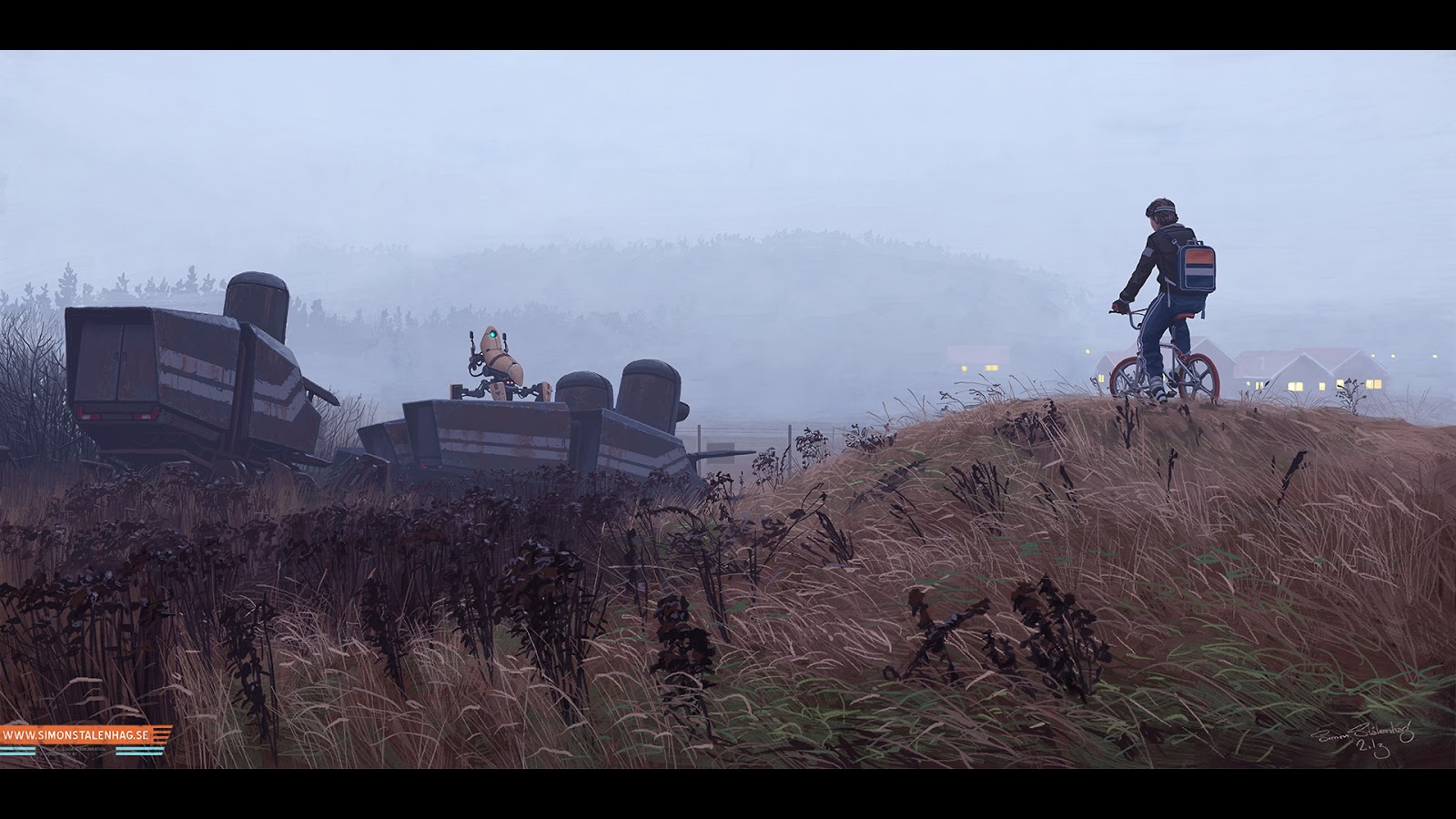
One of the many drawings I've done for my book with the working title Den Sidste Krig - The Last War in English.
I guess the picture above pretty much gives you an impression about what it's all about...
I hope to finish it soon and that it'll be out later this year. For now only in Danish :)


This is one of the main characters, Miss Gunn...


Our protagonist is getting himself trapped by the invaders! What a once-in-a-lifetime experience, huh?


The Great Martian War


It's very well executed, though you can't help noticing how even extra-terrestrial superior beings prefer steampunk and knots and bolts in the early 20th century...

But the soundtrack is really bad - anything would have suited the video better, than this. So turn it sown and watch the invsion in all its artistic splendor :)

Tuesday, May 3, 2016

The Unbearable Lightness of Being Alien


I always bugs me how nearly all aliens in movies, litterature and TV obviously evolved on Earth, left  the planet ages ago, forgot all about it, turned purple, only to return and try to recapture it?
Of course I know that it's about emotions and understanding and seeing ourselves from the outside, but wouldn't it be great if just once in a while something alien - truely alien - turned up?

All aliens seems to have evolved from the exact same branch of vertebrae - mamals - with spine, skull, jaws, arms, legs fingers and toes. They're all very monkeylike. Even those with scales and wings. And this just doesn't add up or make sense.


Nom, nom, nom...
Features:
So lets just talk about the jaw for example:
All aliens have jaws. And they're full of humanlike teeth. 
The vertebrate jaw usually bears numerous teeth and probably originally evolved in the Silurian period. The jaw evolved from the most anterior two gill arches supporting the gills and appeared in the Placoderm fish. This further diversified in the Devonian. The two most anterior arches are thought to have become the jaw itself and the hyoid arch, respectively. So getting yourself a set of gills-turned-into-jaws, and then adding white teeth and fleshy lips on top of them, seems to be the hippest thing since... I don't know.. five fingers? If you want to know more about jaws, there is a neat Discovery documentary about it here.

Of all the animals here on earth it's only vertebrates, that's got this feature and a little googling has made it clear that even though species like fish (including lampreys), amphibians, reptiles, birds, and mammals are vertebrates, more than 95 percent of known animal species on earth are in-vertebrates.
So how come that 95 percent of all alien lifeforms are vertebrates? 
And how about that spine, eh?


How come almost no designers or worldcreators thinks about where and what their beings are coming from? And how a different evolution on a very different planet would affect life. The only way mamals could be on top of things here on Earth is because the dinosaurs died out 65 mio years ago, and left the place to us! 

99.9 % of Star Trek aliens differ from humans so little that you start wonder why they bother putting on the make up at all. I'd love to see aliens being... well, alien for a change. Not even like THE Alien, but alien as in uncomfortably strange.

One of the few TV-programs I find interesting in this way - and inspired me quite a deal - was the Discovery Channels docufiction Alien Planet.  The show uses computer-generated imagery, which is interspersed with interviews from such notables as Stephen Hawking, George Lucas, Michio Kaku and many more. Wayne Douglas Barlowe (Illustrator and Head designer on Avatar and more) has done most (if not all) of the designs of the alien creatures together with the 3D animators, scientists and zoologist, that's contributed to the making of the show. Alien Planet was filmed in Iceland and Mono Lake in California and it's so worth watching. Just remember: It's a docu-fiction, so remember it's not science fact, just imagination. 


I sometimes wonder if aliens - if we ever meet any - have more in common with the oddness and unfamiliarity of the designs of HP Lovecraft than those of George Lucas. 


Friday, February 26, 2016

Why MEN?

Why do we have two sexes. Or more specific: Why do we have men? 


Why waste all that effort and energy in producing and caring for offspring that doesn't carry offspring themselves? Kinda pointless, right?

The maintenance of sexual reproduction in a highly competitive world has long been one of the major mysteries of biology given that asexual reproduction can reproduce much more quickly as 50% of offspring in sexual reproduction are males, unable to produce offspring themselves.

"Almost all multicellular species on earth reproduce using sex, but its existence isn't easy to explain because sex carries big burdens, the most obvious of which is that only half of your offspring—daughters—will actually produce offspring. Why should any species waste all that effort on sons?” lead researcher Professor Matt Gage, from University of East Anglia's School of Biological Sciences, said in a statement. 

Researchers from the University of East Anglia (UAE) believe they may have found an answer, suggesting that the evolutionary force known as ‘sexual selection’ plays a key role in improving population health and protecting us against extinction.

"To be good at out-competing rivals and attracting partners in the struggle to reproduce, an individual has to be good at most things, so sexual selection provides an important and effective filter to maintain and improve population genetic health,” said Gage. 

So - 2 sexes is a major asset, when it comes to a species survival in a competitive enviroment. But would it be so universal that we would expect to find it on other worlds as well? 

Satoshi Kon - Editing Space & Time


Tuesday, November 17, 2015

Shebacca, Her Solo and Lucy Skywalker...


...And the Millennium Falconesse.


I've always loved Star Wars, but I would kinda like to see this version as well. Sometimes it really annoys me how stereotypic genders are portrayed in actions movies. 
Recently I stumpled upon the talented Austrian artist lanimalu, who'd illustrated the hobbits from LOTR as female characters, and I really loved that take on the tale, so I decided to have a go at it myself.
Especially because Han in Danish means Him - so it made sense calling this charming rogue Her :)

Bilba Baggins. Art by lanimalu


Tusken Raiders are people too!


Tuesday, March 17, 2015

The Leviathan - Trailer


Proof of Concept Teaser for The Leviathan. 
Created by Ruairi Robinson.
Developed with the assistance of Bord Scannáin na hÉireann/ the Irish Film Board 


And it looks amazing, even though it's a bit heavy on the symbolic side :)

Tuesday, July 22, 2014

45 Years ago these days the first men walked the Moon!!!


45 Years ago these days Buzz Aldrin and Neil Armstrong walked as the first humans on the lunar surface.

Apollo 11 was the spaceflight that landed the first humans on the Moon, Americans Neil Armstrong and Buzz Aldrin, on July 20, 1969, at 20:18 UTC. Armstrong became the first to step onto the lunar surface six hours later on July 21 at 02:56 UTC. Armstrong spent about two and a half hours outside the spacecraft, Aldrin slightly less, and together they collected 47.5 pounds (21.5 kg) of lunar material for return to Earth. A third member of the mission, Michael Collins, piloted thecommand spacecraft alone in lunar orbit until Armstrong and Aldrin returned to it just under a day later for the trip back to Earth.
 - From wikipedia


What an astonishing feat! I wasn't even born then, but I've seen the footage like a gazillion times, and it's still incredibly exciting to watch. 
They did what people for millennias had been telling stories about: They landed on the Moon! What these 3 guys did, was both to show us what we are capable of and how fragile we are. Just by turning the camera around from the surface on another world, and thereby showing us what an amazing and unbelieveable place we inhabit. I am still in awe... 

Thanks to Buzz, Neil and Michael! #Apollo45 

A New New Hope

Art by James Hance

Star Wars VII Rumors:

Even though some of my posts might suggest otherwise, I just love a good space opera. And I must admit that I'm the biggest sucker for Star Wars. I've always been since I saw for the first time it back in '78. Out of the theatre came a little chubby 7 years old old boy, who felt a veil had been removed from his eyes. 
I read every scifi book there was in the local library, and quickly learned to love Bradbury, Herbert and Asimov. It must have been around the same time I discovered Valérian and Laureline, which I've written about here.


So you can probably guess, that I'm quite excited about the new Star Wars - episode VII - even though I've learned not to get my hopes up too high. But then again - J.J. Abrams cannot possible screw up the Star Wars saga as George Lucas did. Geroge Lucas turned his own creation into the worst pile of pointless gobbledygook through bad directing and overusing VFX. It got so silly in the end (Episode I-III), that even though the designs and visuals in general were stunning, you consciousness never left the theatre while watching the movies.


SO Anyway: According to an article in io9.com article the thing that sets the whole plot in Star Wars VII in motion is Luke Skywalker's hand and lightsaber from The Empire Strikes Back.

The new heroes of the trilogy find it (played by Daisy Ridley and John Boyega), and they decide to return it (the hand too? A bit grose, but hey, so was Jar jar) to the proper people. They run into Han and Chewie, who recognize it as Luke's (the hand or the light sabre?), but they haven't seen Luke since Return of the Jedi (I knew it! Luke just couldn't cope with the fact, that he had a crush on his sis!)."Other details include an ice planet where evil people are building a weapon that can destroy whole solar systems. (Of all the things that survived the great EU purge, I was not expecting the Suncrusher to be one of them).
In many ways this plot of Episode VII is an echo of A New Hope. Instead of R2 coming to Tatooine it's a hand falling from the sky, but the basic sweep of the story is similar, and intentionally so. But things that seem familiar may not be as familiar as you think - don't assume that every ice or desert planet in the galaxy has already been visited, if you know what I'm saying. "


The original article at Badassdigest: here.
Article in io9: here.

AND don't forget to check out J.J. Abrams own little clips (Force for Change) here:


Thursday, July 17, 2014

HALF A BILLION years old ancestors of arthropods found


I just love evolution - if that's possible at all to love a definition. 
But evolution is amazing! Think of all the endless possibilities of life there already has been, the ones that's here now and the ones that will come in the distant future. It really makes my head spin... 

Io9.com just featured this amazing article about these HALF A BILLION years old ancestors of spiders, shrimp and other arthropods. Or possible ancestors at least, since a lot of stuff happens during 500 mio. years. 

Anyone for squidditch? 

Anomalocarids - as they're called - are one of the oldest families of animals on Earth, and they truly looked like something thought up by the combined spawn of H.P.Lovecraft and H.R.Giger. 


From the io9 article:


The connection between anomalocarids and today's animals has long been a source of debate, and some paleontologists believed that there was no way to classify them properly. But thanks to Cong and his team, we have some strong evidence that arthropods — a group containing spiders, crabs, scorpions, and centipedes — are the distant descendants of these anomalocarids.A team of paleontologists led by Peiyun Cong found three gorgeously-preserved anomalocarid fossils in Yunnan Province, and described them today in Nature.
 The main overlap between the two groups, separated by 500 million years of evolution, is their brain structure. Arthropods have segmented, compartmentalized heads like anomalocarids. Plus, their brains connect to those "front appendages" which are called mouth flaps or antennae in today's arthropods. So both groups of creatures shared a very specific physical characteristic, which was a connection between those appendages and the brain.


-Illustration by Nicholas Strausfeld


And above, you can see a side-by-side comparison of one of the fossils (gray) witha a modern arthropod called an onychophoran or velvet worm (green). Long nerves from the frontal appendages extend to paired ganglia lying in front of the optic nerve and connect to the main brain mass in front of the mouth. Anomalocaridids had a pair of clawlike grasping appendages instead of feelers.
New fossil discovery of Anomalocarids actually contains traces of their brain structure — and amazingly, their half-billion-year-old brains look a lot like an arthropod's. Though some anomalocarids may have been as big as 7 feet long, these newly-discovered specimens are closer to the size of today's large insects.
Free Willyanomalocarid!!!!

If you found this interesting, you just might like my post on the origins of life on Earth too.

So just think about all the marvelous alien life there might be out there, beyond the deep, dark and dead vacuum of space, when you see what's been going on this tiny rock. 


Read the article at i09 here.

Read the full paper at Nature.

Monday, July 14, 2014

Simon Stålenhag

The feeling of reality kicking it's ugly boot through the door to the most sacred, most fantastic, most untouched of your childhood fantasies and stories is very strong in the works of Swedish artist Simon Stålenhag. 
The way he combines the most everyday items and locations with the fantastic is spectacular, and I must admit I've never seen anything like it.

Sometimes you're stuck with an image depicting enormous constructions falling apart, rusting and littering the countryside like leftovers from a huge saving-humanity-as-we-know-it experiment gone wrong. Or maybe even gone right, and this is what remains afterwards; A mess next to the highway that people has to pass in their everyday business. 
In our stories we always focus on the heroes, the scientists, the military men, the characters in the middle, but what would the world look like to the regular people after the threat was defeated, and life continued it's regular beat? Probably a lot like this... 


Sunday, March 9, 2014

Some Ground Rules for Alien life

How Stuff Works has a very interesting article about the rules for alien life, written by Craig C. Freudenrich, Ph.D (B.A. in biology from West Virginia University) and Ph.D. in physiology from University of Pittsburgh School of Medicine before completing eight years of postdoctoral research at Duke University Medical Center).


Some Ground Rules for Alien life 

Using what we have learned from life on Earth, what can we say about alien life? While it would probably be vastly different from life on Earth, alien life would probably adhere to certain universal guidelines, as the widely varying life on Earth does. These guidelines or ground rules include the following:Alien life would be governed by laws of physics and chemistry.
Alien life would be based on some type of chemistry (eliminating the sci-fi concept of pure-energy beings).
  • Solvent - On Earth, the solvent for all of our biochemicals is liquid water. Other chemicals could be solvents as well, such as ammonia, methane, hydrogen sulfide or hydrogen fluoride.
  • Temperature - Alien life may require temperatures at which its solvent can remain liquid.
  • Pressure - Alien life may require environmental pressures (and temperatures) that allow solvents to exist in three states of matter (solid, liquid, gas).
  • Energy source - Living things require energy to remain organized. This energy may come from a star or from chemical or geothermal energy (as in hydrothermal vents and hot springs). On any alien world, there would have to be some source of energy to sustain life.
  • Complex molecules - Living things on Earth are organized and made of complex, carbon-based molecules that carry out biochemical functions. Carbon is a versatile atom that can form bonds with up to four other atoms, in many shapes, to make molecules. Although not as versatile as carbon, silicon can also form up to four bonds with other atoms and has been proposed as a basis for molecules of alien life (silicon-carbon hybrid molecules have also been proposed). It is likely that alien life forms would have some type of complex molecule to carry out similar functions.
  • Informational molecule - In Earth organisms, deoxyribonucleid acid (DNA) is a complex molecule that carries genetic information and directs the formation of other molecules in order for life to reproduce and function. Because a characteristic of life is that it reproduces, it seems likely that alien life forms would also have some type of informational molecule.
Alien beings that are larger than microbes would have some equivalent of cells. As an organism gets larger, its internal volume (cubic function) grows faster than its surface area (square function). This places a limit on the organism's size, because substances from the outside of the organism must pass into and throughout the organism by diffusion, which depends upon large surface areas, short distances and differences in concentrations. As an organism grows larger, the distance to its center increases and diffusion gets slower. To maintain workable diffusion distances, an organism must have many small cells instead of one large cell. So, an alien would be multi-celled if it is larger than a microbe. 
Alien life would evolve and adapt to its surroundings by the theory of evolution as previously explained.
The physiological make-up of a multi-celled alien would be most suited to its environment. Organ systems would be adapted to environmental conditions such as temperature, moisture and gravity. 

  • The alien would have some way of bringing solids, liquids and gases inside its body, distributing them to every cell and removing waste products (equivalents of heart, blood vessels and kidneys, for instance).
  • The alien would be able to take in energy from its surroundings, extract the energy and eliminate wastes.
  • The alien would have senses (such as sight, sound, touch) to obtain information from the environment and respond to stimuli (while we use vision as our primary sense, this may not be true of aliens). They would also have some type of brain or nervous system to process information.
  • The alien would have some means of reproduction, either sexual or asexual.
Alien organisms would probably have similar ecological structures to life on Earth.
  • Population sizes would be limited based on the predominance of food, predators, disease and other environmental factors.
  • Alien life forms would exist in food chains and food webs in their native environment, like life on Earth. Producers will make food, consumers will eat producers and/or other consumers and decomposers will recycle atoms and molecules from dead organisms back into the environment.
  • Alien life forms will be integrated with their habitats and ecosystems, like life on Earth.
As you can see, life of any kind is intimately tied to its environment, so the characteristics of the planet would be extremely important in determining the characteristics of the life form. 
A very nice article with a very straight forward approach, focusing on the nature and evolution of an alien world and whatever life might be found there. Especially that life on that planet ought to fit into it's native ecosystems, even if it has removed itself from it's natural place in the food chain (E.g. via civilisation), it would still have kept the same traits, physically as well as psychologic.
Talking about food chains and ecosystems: That might cause problems if we ever decide to colonize alien planets already containing native lifeforms - how would we fit in? Would we be able to digest anything at all from that planet? And how would our dead bodies on the other hand decompose on the alien world, without risking a genocide?

Art by Alex Ries

Thursday, January 30, 2014

Alex Ries

Alex Ries is an Australian illustrator and concept artist, currently based in Melbourne.
He is probably best known for his original approach to creature design and has worked with clients including book publishers, videogame developers and the scientific and medical communities.

His education and experience, coupled with a strong interest in biology, zoology and real-world technology, has fostered an amazingly artistic style able to not only accurately illustrate life from the real world, but fictional life as well.

He's been doing this for years and for a range of medias, but especially his thought and designs on aliens are interesting. They all seems very applaudable and real, and you accept them on the spot as living beings.
His designs, colours and the way he poses and presents his creatures makes you think more in the lines of BBC nature and historic programs than Star Wars I-VI. It's all got this underplayed tune running as a red line throughout most of his artwork.

Birrin:
And even though most of his stuff is worth a close study, his Birrin project close to being his most fascinating one.

The Birrin are a sentient hexapod (six limbed) living on a Venus sized home world. And they seem to enjoy life immensely! They do drugs, socialize, explores, hunts and fights with great enthusiasm.
He illustrates and writes small scenarios of their social and cultural development through the ages, which is not quite unlike ours.
I really like their designs very much and I am always eager to see more about the Birrin.


If I have to put my finger on anything, it has to be that I still need to see where they really differ from us, other than in their apperance. What's their psyche like? When threatened, how do they react?
I am aware that some theories works with the idea, that civilized alien species will have more in common than not (read interesting io9 article here), but what if they for example communicated via chemicals? How would that effect their cultural and technological development? Stuff like that...
But that's minor details. I still find them more believable than the Na'vi... 

Alex Ries uses his Deviantart account both as a gallery for his brilliant art as well as as a puplic forum, where he posts thought for general debate and decision making on anything related to his works. 

For a short introduction to him, his works and his thoughts, don't hessitate to watch this wee video presentation made in connection with a course he gave at Phoenix Atelier in the fall of 2013. 


Sunday, January 26, 2014

Origin of Life?


One of the questions that's been annoying me for years is this: What is the point with life?
Not "what's the point" in any general or philosophical way, but literally: What IS the point?
And don't bother bringing God into this. It's a whole other discussion, and I'd be happy to take that up later, but for now I'm on another mission.

Because what is the point with life?

Everything else in the universe seems to fall into some patterns or laws, which gives some kind of purpose. Gasses come together and form giant clouds that becomes structures that becomes stars and planets - all bound by laws of physics. The planets are kept orbiting stars, stars orbiting the galaxy etc. It makes kind of sense! It's there because it cannot not be there! It's a kind of universal evolution. I'm probably speaking against better knowledge, but then I'd love to be educated. Life doesn't seem to follow laws as such. It's just a byproduct - something that accidentally popped up on this tiny cockwheel in the universal clockwork.

So how did life come to be? Is it a physical reaction of chemicals and lightning, or a freak accident?


A young MIT scientist, Jeremy England (By the way - isn't that just the coolest name for a science guy ever?) has come up without very interesting thesis: Life evolved out of a necessity on an atomic scale:
"From the standpoint of physics, there is one essential difference between living things and inanimate clumps of carbon atoms: The former tend to be much better at capturing energy from their environment and dissipating that energy as heat. 
Jeremy England, a 31-year-old assistant professor at the Massachusetts Institute of Technology, has derived a mathematical formula that he believes explains this capacity. The formula, based on established physics, indicates that when a group of atoms is driven by an external source of energy (like the sun or chemical fuel) and surrounded by 
a heat bath (like the ocean or atmosphere), it will often gradually restructure itself in order to dissipate increasingly more energy. 
This could mean that under certain conditions, matter inexorably acquires the key physical attribute associated with life."   
He states that the origin and evolution of life are processes driven by the fundamental laws of nature — namely the Second Law of Thermodynamics. He's come up with a formula showing how a group of atoms, when driven by an external source of energy (like the sun) and when surrounded by a heat bath (like the ocean or atmosphere), can sometimes restructure itself as a way to dissipate increasing rates of energy.

So, according to the Jeremy England, the origin and subsequent evolution of life follow from the fundamental laws of nature and “should be as unsurprising as rocks rolling downhill.”

“You start with a random clump of atoms, and if you shine light on it for long enough, it should not be so surprising that you get a plant,” England continous.
The thesis has gained a lot of response from the scientific community - responses reaching from  "interesting" to "absurd" and "pure speculation."
I'd go with "interesting" here, because it kind of makes sense to me. 
Of course, this planet could for all we know be the only one with any kind of life on it. We might just have to face the fact, that we are alone in this universe. But it would be odd, wouldn't it?

I guess that if the theory of Jeremy England is true, chances on finding traces of life on Mars just got beefed up...
Wanna know more? //www.simonsfoundation.org/quanta/20140122-a-new-physics-theory-of-life/

Wednesday, September 7, 2011

Idolomantis diabolica


This bug is just... striking, I guess the correct term is.
It's the "Idolomantis Diabolica" - also depictured above...
An awesome little trooper.


Wednesday, August 10, 2011

It really is a huge universe...


I really haven't got a lot to say but this: It's an enormous clock, and we're but corner goo on a minor cogwheel...

Wednesday, June 1, 2011

What is a jellyfish?


Alien jellyfish is the 90'es equivalent of the 50'es bug-eyed aliens. They're still alien to behold, but sooo peaceful and tranquil. Like the hippies of the deep sea.

Having said so this little movie is quite a treat - and it reminds us just how strange these creatures are - and that a jellyfish isn't just any jellyfish. Our definition of "jellyfish" looks a bit daft after watching this, since said definition basically just is a large box containing whatever looks see-through and wobbly found anywhere near water. They aren't the same species for a start. So watch and learn. I'm amazed here. 

And here I haven't even been taking up on the Awwwww! factor. It looks awesome.

Enjoy the movie :)